

You've been studying Japanese for five years. You passed N3. You finished the textbook. You did the workbook. You did the second workbook. You can read a menu, mostly. You can write your address. You know more grammar points than most native speakers can name.
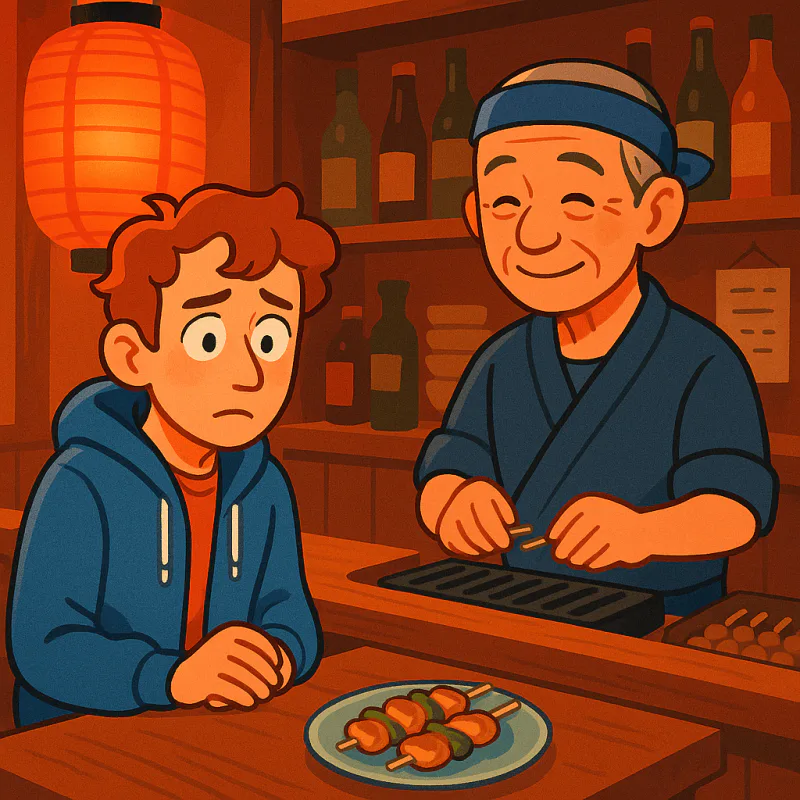
Then you sit down at the counter of a small izakaya, the master asks you something casual about the weather, and your brain freezes. You answer in three words. He smiles politely and turns to the next customer. You eat your skewers in silence and tell yourself you'll study harder next week.
This story is so common among foreigners in Japan that it should not be surprising anymore. And yet every person it happens to walks home convinced the same thing: their textbook failed them, or their teacher failed them, or the JLPT failed them, or the system itself is broken.
It isn't. The class is the floor, not the ceiling.
Here is the math nobody does. Two ninety-minute Japanese classes a week, for forty-eight weeks a year, for five years. Comes out to about seven hundred and twenty hours of study. That sounds like a lot until you compare it to how a child actually learns to talk. A toddler hits seven hundred hours of Japanese input by the time they're nine months old, and they still take another three years before anyone calls them fluent.
The classroom was never going to deliver fluency by itself. It was never built for that. Class time gives you the rules, the vocabulary, the structures, and a slow, supervised place to try them out. It is the equivalent of being shown how to swim from a chair next to the pool. Useful. Necessary, even. But you are not going to get faster at swimming until you are actually in the water, breathing, panicking, and adjusting in real time.
The people you know who became fluent did not have a better class than you did. They had something you did not have. They had unscheduled hours. Hours where they watched a Japanese show without subtitles and got nothing for the first twenty minutes and stayed anyway. Hours at a bar listening to a conversation they were not part of. Hours typing messages to a friend, deleting them, retyping them, sending the wrong one anyway. Those hours don't show up on any transcript. They are the hours that make the difference.
The standard response to the izakaya freeze is to assume you bought the wrong textbook. Or that your teacher is too easy. Or that you should switch to a different app, a different method, a different tutor. There is a whole industry built around selling you the next better class.
It is mostly a trap. More classes won't save you. Because the thing you're missing is not on the curriculum side. It is on the volume side. You can switch from Genki to Tobira to a private tutor to a six-month immersion program and still come out the other end unable to talk to the master at the izakaya, because all of those formats keep you in the same posture: receiving language, not producing it under load.
I am not saying classes are useless. They are excellent. But somewhere around the time you finished your first proper textbook, you stopped getting linear returns from them. The next textbook teaches you slightly fancier grammar to do things you can already do. What it does not teach you, and cannot teach you, is the reflex of speaking when you don't have time to think.
That reflex is built somewhere else.
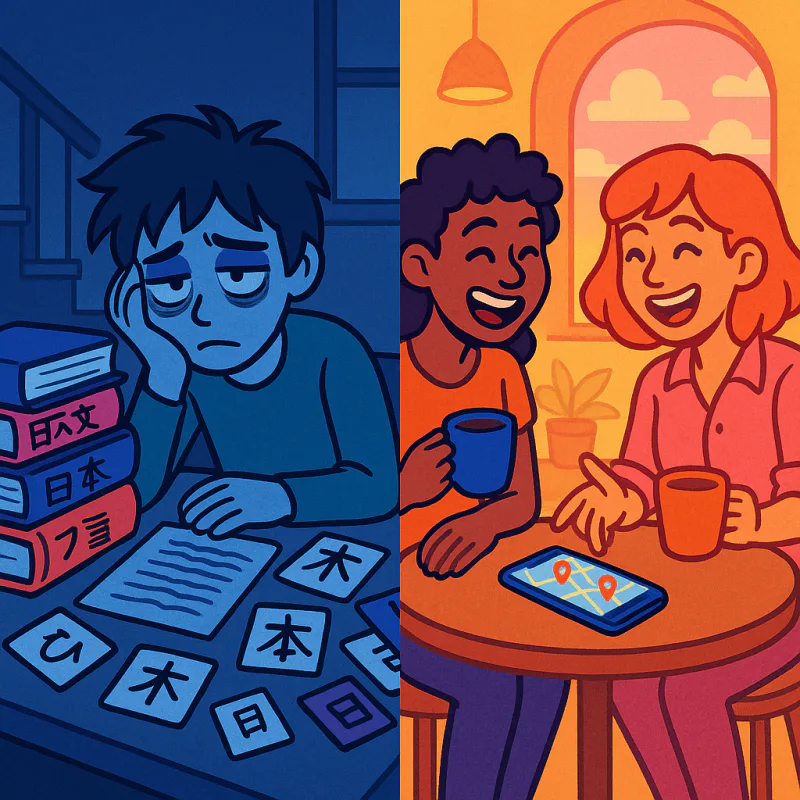
You already know this from anything else physical you have ever learned. You did not get good at riding a bike by reading about pedaling. You did not get good at cooking by watching cooking shows. You got good by doing the thing repeatedly, badly at first, and slowly less badly.
Speaking a language is the same shape of skill. You can study the rules forever and still not have the reflex, because the reflex is not stored in the part of your brain that reads. It is stored in the part of your brain that talks. And the only way to train that part of your brain is to put it in conversations and let it stumble.
The thing is, your brain does not actually mind stumbling. It minds stumbling under threat. High stakes plus low volume equals zero learning. Which is why your brain freezes at the izakaya, freezes at the city office, freezes when a coworker asks you something casual in the hallway. None of those situations let you stumble safely. Each of them costs something. So your brain does the rational thing and shuts up.
What it needs instead is hundreds of small, low-stakes reps. Reps where being wrong is funny instead of expensive. Reps where the other person has time and is not in a hurry. Reps that don't exist in your schedule, because nobody put them there. So you have to put them there yourself.
Here is the thing that sounds too simple to work, and works anyway. Two coffees a week beat a year of textbooks, once you have the basics. Not because coffee is magic. Because two hours of voluntary, unstructured speaking with a real human, every week, for a year, is roughly a hundred hours of the exact reps you cannot get anywhere else.
A hundred hours of speaking under no pressure. A hundred hours of trying a sentence, watching the other person's face, noticing they didn't quite understand, rephrasing it on the fly. A hundred hours of hearing real Japanese spoken at real speed by someone who has zero incentive to slow down for a textbook reason and every incentive to slow down for you, because they are your friend.
That is what closes the gap. Not the next class. Not the next app. The unscheduled hours where you are talking, awkwardly, with someone who is on your side.

Stop reading the next chapter. The next chapter is not why you froze at the izakaya. Find one Japanese person who lives nearby, who has a free hour, and who is interested in trading a coffee for a conversation. Tell them your Japanese is at the level where you can technically speak but freeze in the moment. Most people find that endearing. The ones who don't, you'll know inside ten minutes, and you can move on.
Do this twice a week for a month. You will not become fluent in a month. But the freeze will start to thaw. You will catch yourself answering the master's weather question before your brain has time to panic. You will hear a phrase a friend used last Thursday come out of your own mouth on a Tuesday. That is the reflex, finally, beginning to build.
After three months of this, you will not be the same speaker you were when you were stuck on the textbook treadmill. Not because the textbook was wrong, but because you stopped speaking the moment class ended. And now you don't.
The hard part of this advice has always been the logistics. Most people don't have a Japanese friend lying around who happens to be free on Wednesday afternoons. The classroom does not introduce you to one. Language exchange apps full of strangers in different time zones don't really count, because typed messages are not the reps you need. You need the in-person ones. The ones where you can read a face.
Make Japanese Friends On a Live World Map
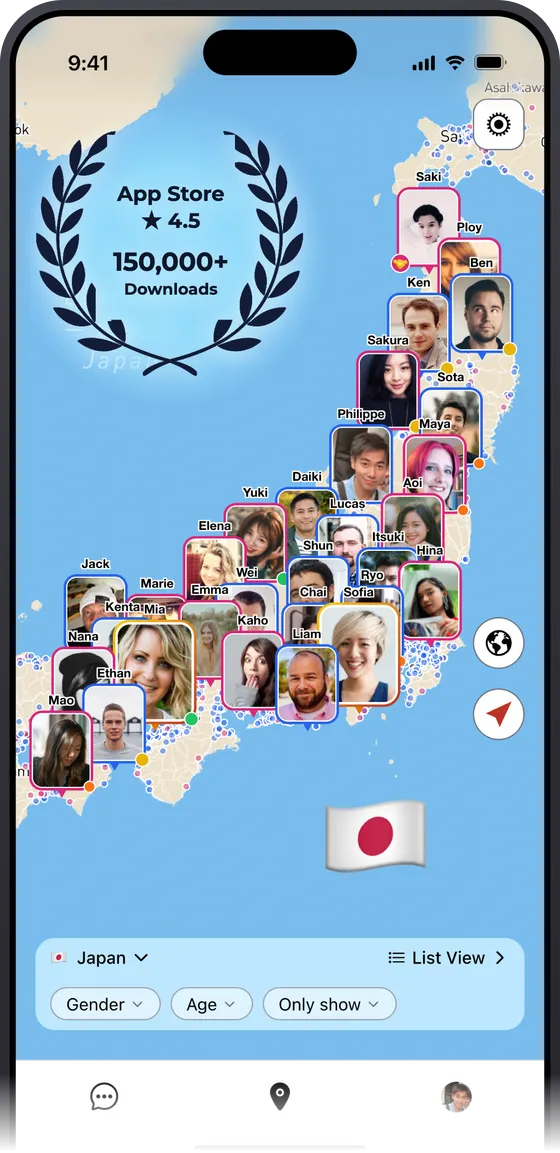
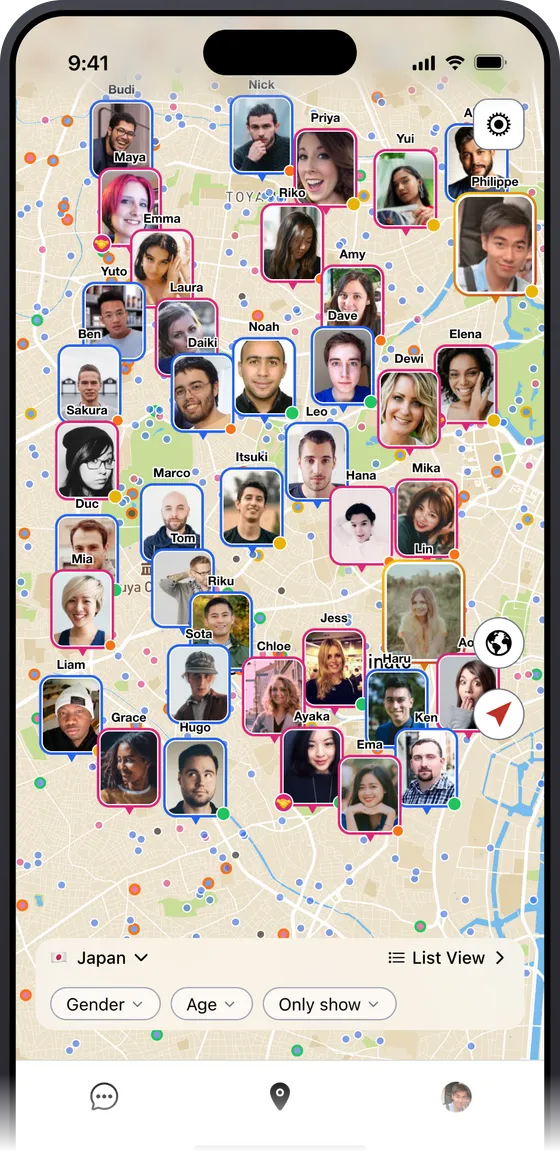
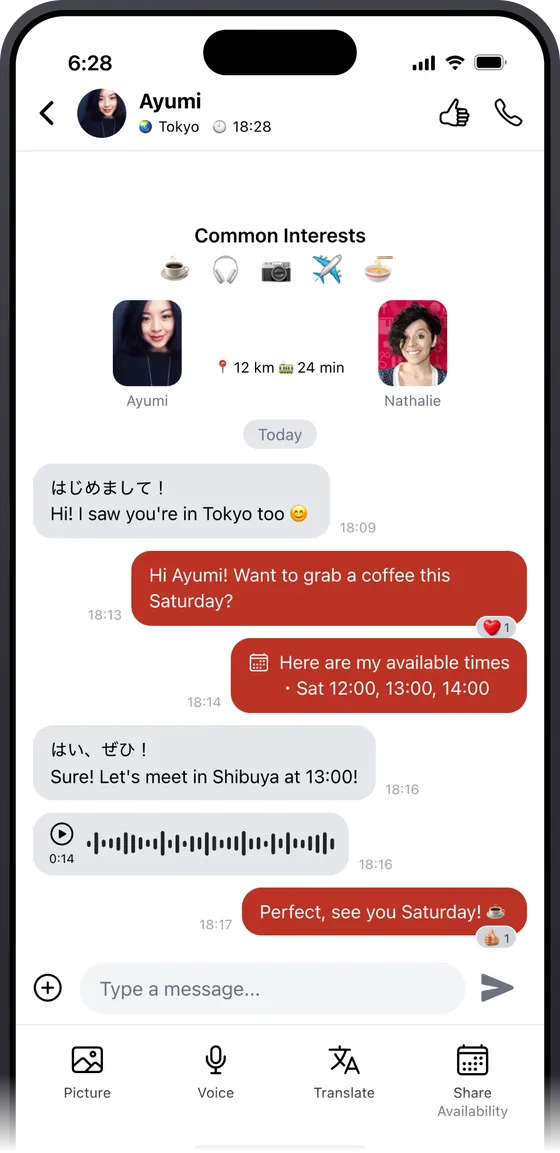


SewaYou is a map-based app for finding people who are actually nearby and actually want to meet up in person. You can see who is in your city, who is also learning a language, and who is open to a coffee this week. Nobody is grading you. Nobody is on a deadline. Just a real chair, a real cup, and a real conversation where being wrong is fine.
Five years of class got you to the door. The door opens from the inside, one quiet afternoon at a time. Start stacking the afternoons.


