

You finally pushed past the nervousness. You opened your mouth in a group of native speakers and said the thing you had been rehearsing in your head for the last twenty minutes. Two sentences in, one of them caught a word you mispronounced and repeated it back to the room, laughing.
You laughed too, because what else are you going to do. Then you asked, calmly, "Wait, how is it actually pronounced?"
Nobody answered. The conversation moved on. You sat there with the wrong pronunciation still in your mouth and a little hole in your chest where your enthusiasm used to be.
The next time you were in a similar group, you didn't speak. The time after that, you started avoiding the kind of gatherings where speaking would be expected. Three months later you had a perfectly good vocabulary in your head and almost no opportunities to use it.
That one moment cost you half a year. The worst part is you can't even point to anyone obviously cruel. They just laughed and didn't correct you.

Mocking the way someone speaks a language isn't the worst thing a native speaker can do to a learner. The worst thing is the silence after the laugh.
If they had laughed and said "oh, it's actually pronounced like this," you would remember the correction forever. You would probably even tell the story later as a funny moment. The laugh would have been part of the lesson.
What broke you wasn't the laugh. It was being asked, by the rhythm of the moment, to repeat the wrong version for entertainment, then watching the conversation move on without anyone handing you the right one. Mocking is not feedback. Feedback fixes the mistake. Mocking just enjoys it.
Once that pattern lands on you a few times, your brain quietly starts marking "speak Japanese" as a high-cost activity. You stop volunteering. You stop pushing into harder grammar. You wait until you are absolutely sure before you open your mouth, which means most of the time you don't.
When you tell people about a moment like this, the most common response is "you just need more native speaker contact, get back out there." That advice assumes all exposure is good exposure. It isn't.
Exposure to people who treat your mistakes as content makes you worse, not better, because the mistakes you needed to correct out loud are exactly the ones you now refuse to make out loud. Volume is not the bottleneck. Safety is.
I used to think the fix was to harden up and care less what strangers thought. That sounds noble in a journal entry. It does not actually work in your nervous system. Your brain is wired to avoid social pain, and after enough small humiliations it will start avoiding the language itself, not just the room.
The serious fix is upstream of the conversation. It is choosing who you practice with in the first place.
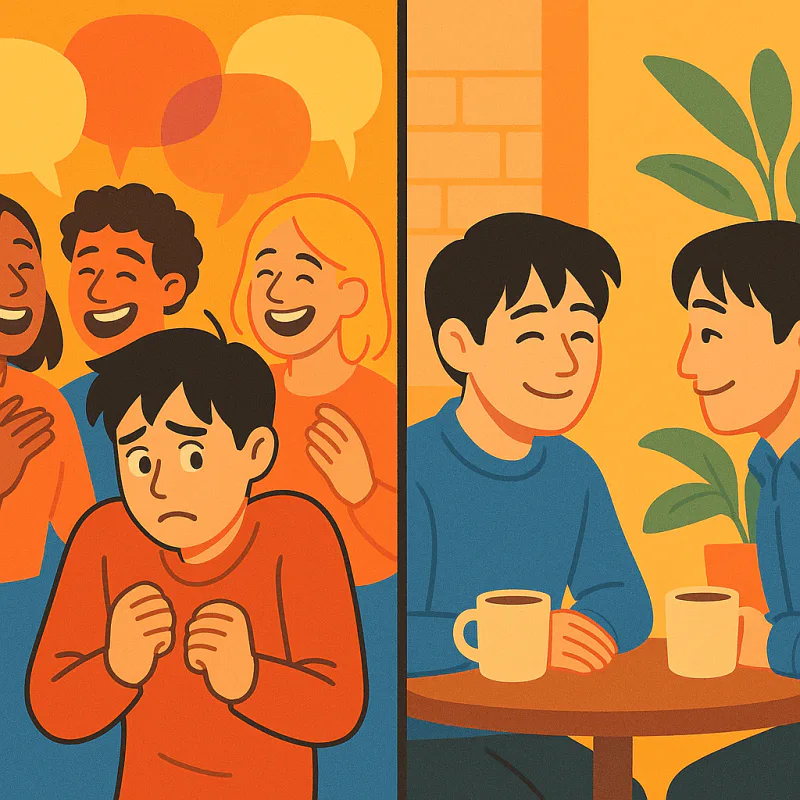
A real practice partner is not just any Japanese speaker who is willing to talk to you. The bar is higher than that, and it has nothing to do with how good their teaching is.
A real practice partner is someone whose mood does not get better when yours gets worse. Someone who, when you mispronounce a word, treats the mispronunciation as information about what to teach you next, not as the punchline of the next ten minutes. Someone who, if you ask "how do you actually say this," will stop and tell you, even if it interrupts the flow of whatever they were saying.
You can usually tell within the first fifteen minutes. The signal is small. Do they slow down naturally when they notice you straining, or do they speed up because it is funnier? Do they repeat your error back with the correction attached, or just with an eyebrow raised? Do they ask you anything about yourself, or are you only useful as a curiosity?
Pick your audience first. The grammar is the easy part. Finding someone safe to be wrong in front of is the actual problem you are solving.
The instinct most learners have is to practice with whoever happens to be in the room and hope it goes well. Then, if the person turns out to be cruel, you absorb the damage and move on.
That is backwards. The damage from one bad conversation can quietly take six months off your speaking confidence, and you cannot undo it by having a good conversation later. You can only prevent the next one.
So filter first. Before you commit to a regular language exchange, a hangout, a meet-up, ask yourself one question. Is this person curious about me as a human, or am I a bit of entertainment for them. If the answer isn't a clear yes in the first hour, do not put your fragile speaking confidence in their hands a second time. Be polite, finish your coffee, find someone else. There are a lot of Japanese speakers in this country. Most of them are kind. You only need a small handful of the kind ones to learn the language properly.

Stop trying to practice in groups for a while. Groups are where the mockery happens, because there is an audience to perform for. One on one, almost nobody is mean. The math of cruelty needs spectators.
Find one person, ideally close to your age, ideally someone who has spent time outside Japan and knows how it feels to be the foreigner in the room. Meet them somewhere quiet. Tell them you mess up a lot and you would love to be corrected when it happens. Most people will be flattered to be asked. The ones who aren't will reveal themselves quickly, and you can move on without having paid much for the information.
Do that twice a week for a month and the version of you who stopped speaking after the bad group conversation will start coming back. Not because your grammar got better. Because the room finally feels safe.
The hard part is the same hard part it always is. You do not have a roster of patient bilingual people sitting in your phone waiting for you to call. The classroom does not give you one. Random apps full of strangers across time zones do not really give you one either, because the kind of safety you need only really lands in person.
Make Japanese Friends On a Live World Map
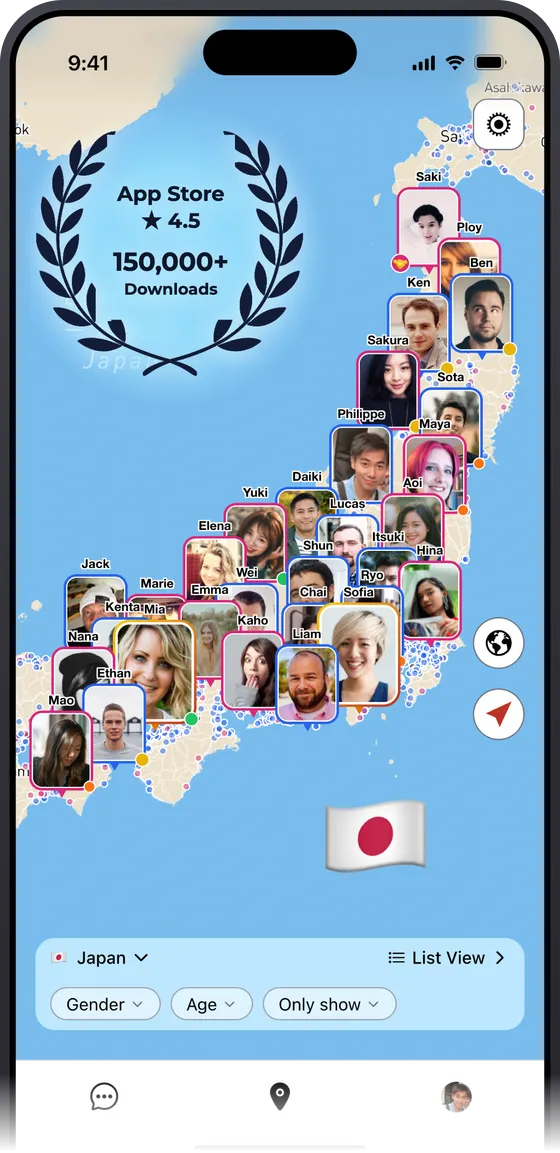
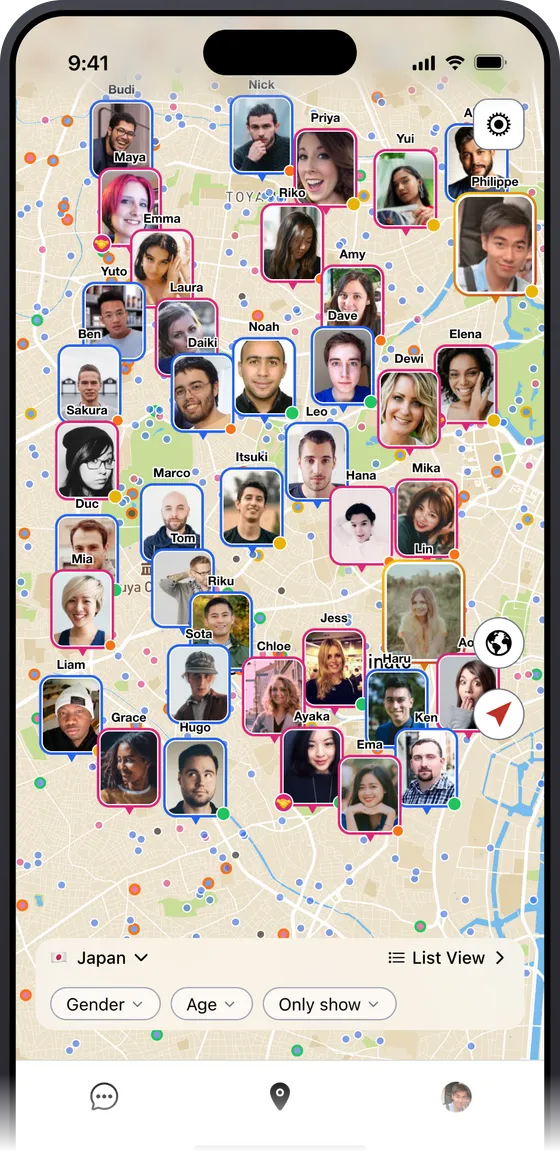
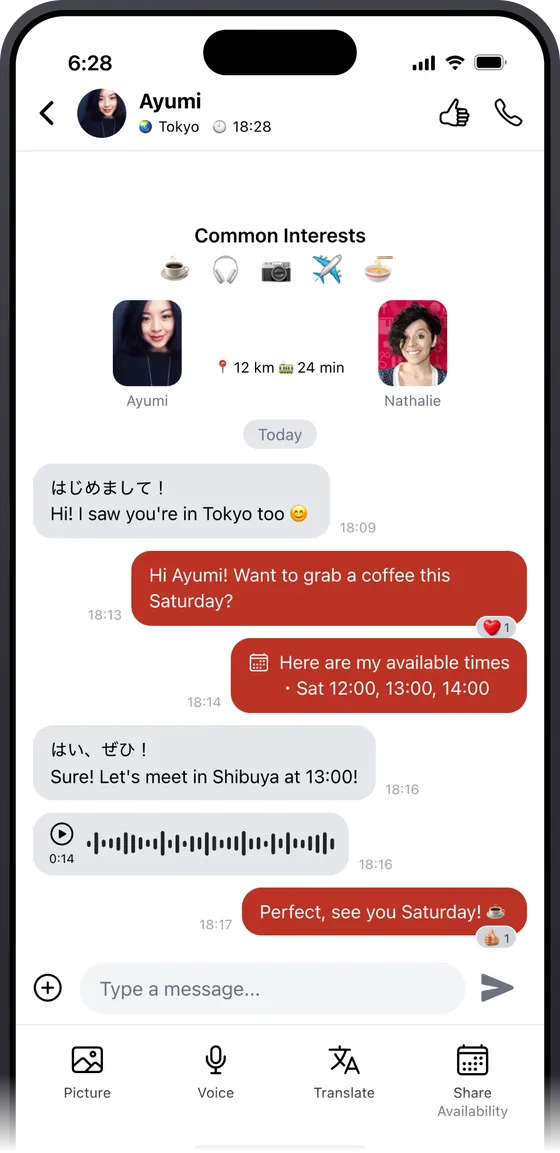


SewaYou is a map-based app for finding people who are nearby and actually want to meet up. You can see who is in your city, who is also learning a language, and who is open to grabbing a coffee in person. Nobody is performing for an audience. Nobody is collecting your mistakes for a story later. Just one chair, one cup, and one quiet hour where being wrong is allowed.
The native speakers who laughed at you are not the ones who are going to teach you the language. The ones who are going to teach you the language are sitting somewhere on a map, waiting for you to ask.


