

You walk into the konbini you've been going to for three years. You pick out an onigiri and a coffee. You hand over your card. The staff says one short sentence to you. Just one. And your brain locks up like an old laptop.
You knew the words. You'd known them the first month you got here. You know exactly what the question means when you see it written down. But the sound came at you at conversation speed, and the part of your brain that should have answered was still buffering. So you said the only thing that was already loaded in the chamber.
「あ、はい、お願いします。」
You walked out the door not actually sure what you'd just agreed to. Maybe a warmed bento. Maybe a bag. Maybe both. Maybe a survey.
This happens to people at every level. People with N2. People with N1. People who can read a tax notice and translate a manga panel for fun. The freeze is not about vocabulary. It's about the gap between knowing a language in your head and processing it in real time at the register. Almost nobody talks about this gap, because once you cross it, nobody remembers what the other side felt like. So you walk around assuming the freeze means your Japanese is broken. It isn't. Your Japanese is fine. Your real-time is what's slow. Two completely different muscles.

The thing nobody tells you when you're studying for the JLPT is that the test mostly checks one of those skills. You can read a passage at your own pace. You can rewind the listening section in your head. The clock matters, but it doesn't speak at you the way a tired cashier does at 9 in the morning when there are three people behind you.
Real-time listening is the worst kind of pressure. You don't get to pause. You don't get to ask for a slower version. The other person has zero context that you needed an extra two seconds. Every second your brain spends processing what they said is a second they spend wondering if you understood, which makes you panic, which makes you process worse. It's a feedback loop with no good exit.
This is why people who've lived in Japan for five years still freeze at the post office. Not because they forgot Japanese. Because the post office uses sentence patterns the rest of life doesn't, and their brain doesn't have a fast path for those patterns. The patterns they do have a fast path for, like ordering coffee or asking where the bathroom is, run smooth. Everything else has to load.
You don't fix this with grammar. You fix it with reps. Specifically, the kind of reps you cannot get from a textbook.
You will be tempted, after a freeze, to come home and crack open a book. That feels productive. It feels like the right response to a failure. It is mostly the wrong response.
The book teaches your reading brain. The reading brain is already fine. Adding more vocabulary to a brain that already knew 温めますか on paper does not help the version of you standing at the counter who froze on the audio.
What you actually need is sound, in your ear, in real situations, low enough stakes that your nervous system can stop ringing the alarm bell every time you don't catch the first syllable. You need to fail at hearing twenty things and be okay. You need to ask 「もう一回お願いします」 ten times in a week and survive it. You need to sit across from someone who is not in a hurry while they say a sentence you almost catch, and let yourself say "wait, the second part?" without your face going hot.
That is not a thing you can buy from a book. That is not a thing you can grind from an app full of strangers you'll never see again. That is a thing you build with patient humans.
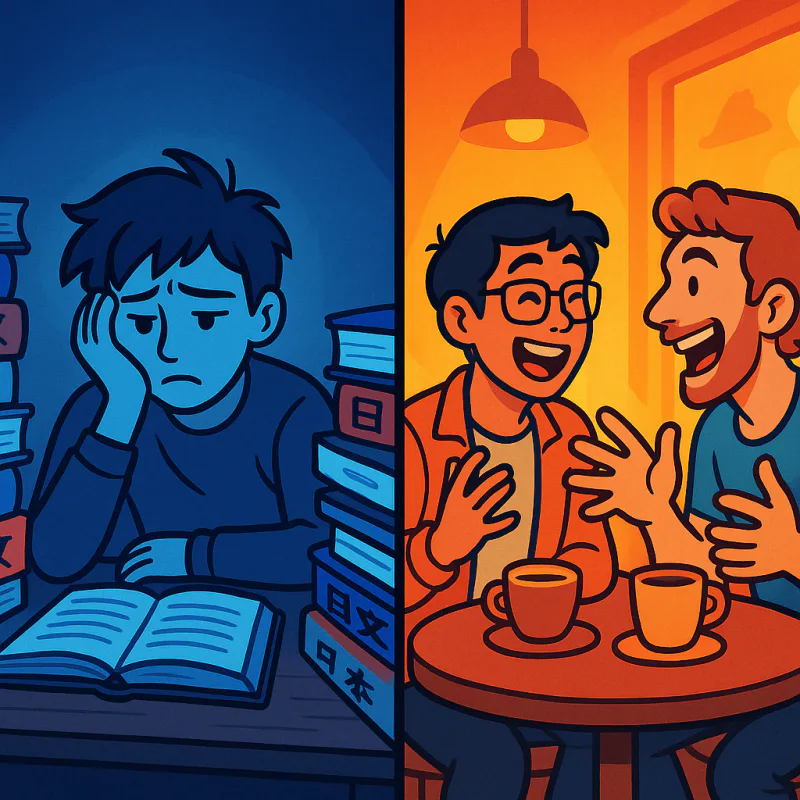
Here is the part that takes a long time to accept. You get fluent in real-time Japanese the same way you get good at any reflex. You expose yourself to the situation, you fail badly the first ten times, you start failing less, and one day you realize the cashier said something and you answered before you noticed you understood.
The cost of a single rep is what makes or breaks the whole project. If every rep is high-stakes, like a real bank teller or a real boss or a real cashier with a line behind you, your nervous system spikes every time and you only get one rep per week before you start avoiding the situation entirely. If every rep is cheap, like an afternoon coffee with someone who knows you're learning, you can stack thirty reps in a month and your brain will quietly rewire itself.
This is the part of language learning that classrooms do not understand. The classroom thinks the answer is to make the lesson harder. The actual answer is to make it lower stakes so you can do it more times. Volume of reps under low pressure beats intensity of reps under high pressure every single time.
The freeze at the konbini is your nervous system telling you it has not had enough cheap reps. It is not telling you to study more. It is telling you to talk more, with someone where it doesn't matter if you mess up, until the same sound that froze you stops feeling like an ambush.

Find one person who is not grading you. Not a teacher. Not a colleague. Not the cashier you'll have to face again tomorrow. Someone whose only job during your conversation is to enjoy talking to you.
Meet them somewhere you can hear each other, and make a deal with yourself that the goal is not to perform Japanese. The goal is to ask 「もう一回?」 as many times as you need to. That's it. That's the rep. Two of those a week and the konbini will start feeling different inside of two months.
You're not slow because your Japanese is bad. You're slow because you have not given your brain enough quiet, low-stakes hours of listening to actual humans talking at the speed they actually talk. That is fixable, just not from a desk.
The trick to making this consistent is having someone to actually meet up with. Not a stranger you swiped on, not a chatbot, not a paid teacher who is invested in correcting you. Just a regular person nearby who also wants to talk.
Make Japanese Friends On a Live World Map
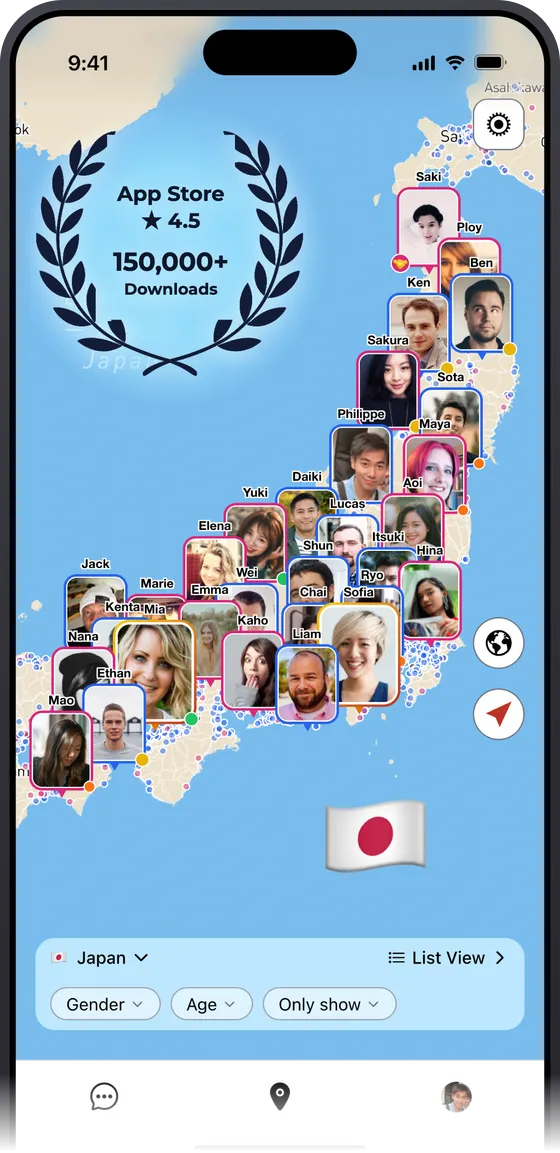
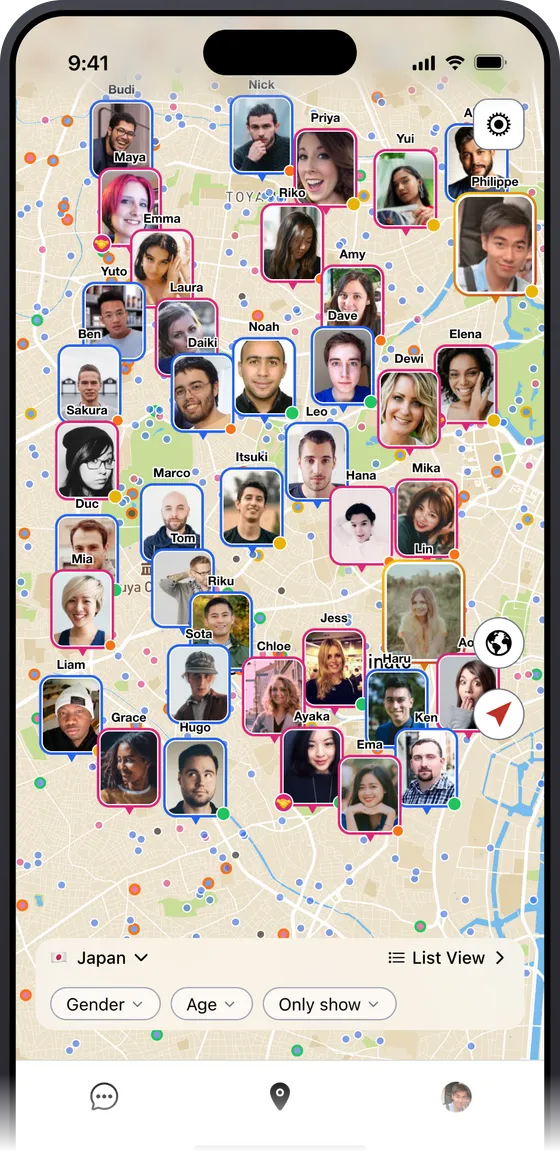
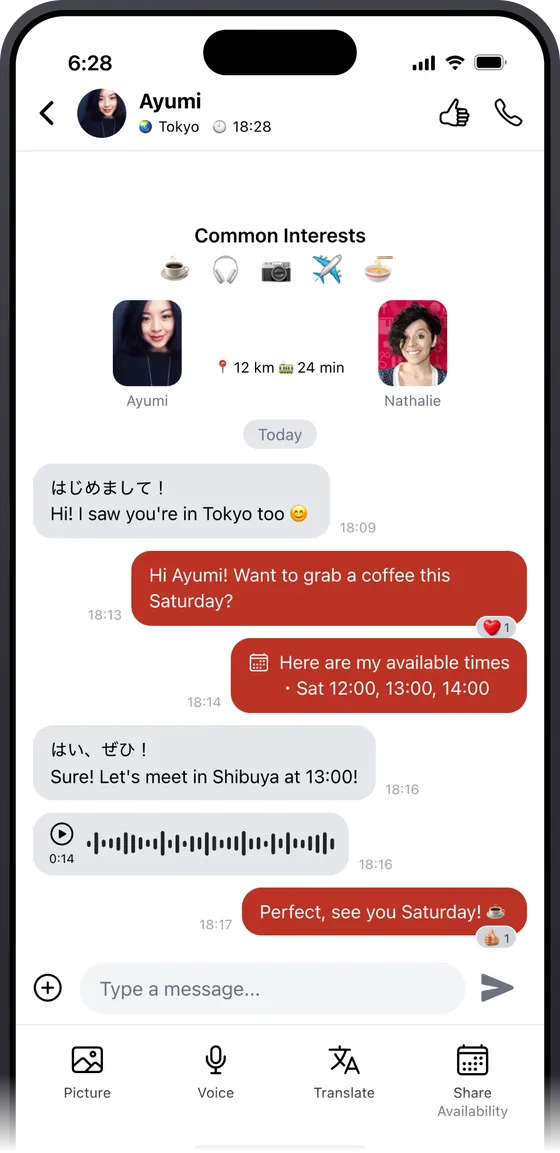


SewaYou is a map-based app for exactly that. You see who's around, who wants to meet up for coffee, who's also learning a language and willing to be patient with yours. Nobody is auditioning. Nobody is timing your responses. You can ask for a sentence to be repeated three times and the whole afternoon keeps going.
The freeze at the register goes away one quiet conversation at a time. Build the conversations, and the freeze takes care of itself.


