

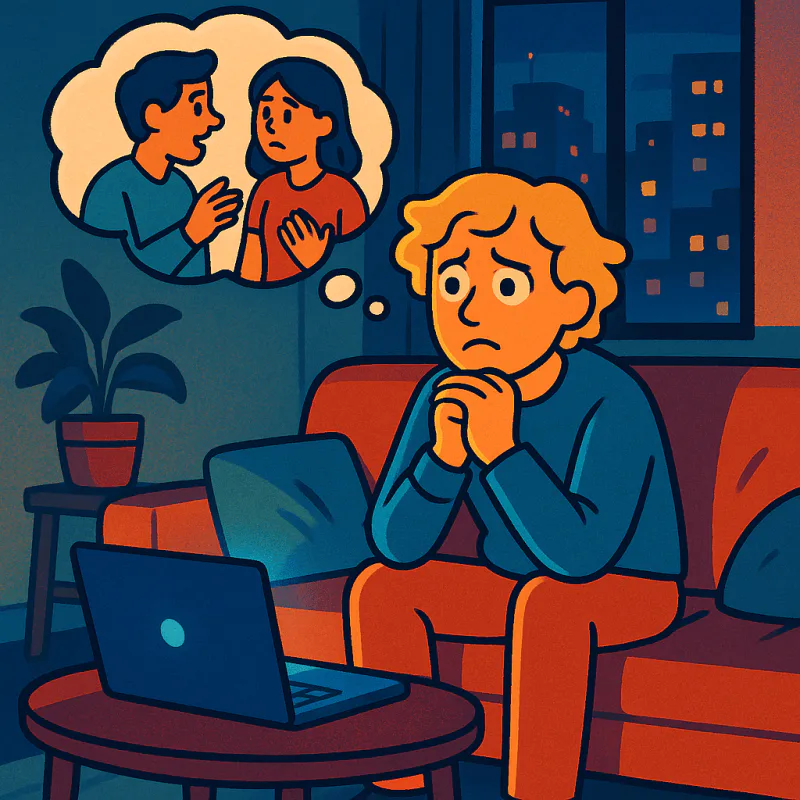
You moved to Japan. Six months in, your boss says something that lands wrong. You go home, lie awake replaying it, and the next morning ask the only Japanese-fluent person you trust, who happens to be another foreigner, what they think. They tell you the boss was out of line. You feel better for an hour. Then you remember they said the same thing about your landlord, and your city office clerk, and the lady at the post office. Suddenly you are not sure if everyone in Japan is crazy or if you are.
This is the foreigner-in-Japan calibration problem and almost nobody talks about it directly. You arrived without a baseline for what is normal here. Every interaction that feels off could be a real cultural misalignment, where you are the one who needs to adjust, or it could be a person being a jerk, where the right move is to push back. You cannot tell from inside your head. You need outside readings, and the outside readings you have access to are usually all from one side.
One-sided friend groups break your judgment.
I have watched two failure modes for years and they are mirror images of each other.
The first is the foreigner who has only foreigner friends. Every problem becomes evidence that Japan is broken. The boss who micromanages, the rule about garbage day, the colleague who never invites them to lunch, all of it gets folded into the same story. Within two years they are bitter, exhausted, and certain the country is gaslighting them. They never stop to ask whether half of those things are actually fine and just need a small adjustment in expectation.
The second is the returnee or long-term resident who has only Japanese friends. Every problem gets explained away. "That's just how senpai are." "That's how the lab works." "Don't make meiwaku." Slowly they learn to swallow real mistreatment because the people around them have also swallowed it, and questioning it feels like an attack on the whole culture. Five years in, they cannot distinguish what is them being out of step from what is somebody else being abusive.
Both groups think they understand Japan. Neither does.
Real understanding lives in the overlap. A Japanese friend who has worked in mixed environments, or a foreign friend who has lived here long enough to actually see the spectrum, can tell you when something is normal and when something is not. The single test that nobody can do alone, two of you can do in five minutes over coffee.
A friend of mine, returnee, half-Japanese, spent her first year of grad school in Tokyo certain her supervisor was abusive. He gave her vague instructions, then criticized her for "lacking consideration" when she asked clarifying questions. She had only foreign friends in her cohort. Every time she described what happened, they said "that's harassment." So she lived in a state of constant anger, planning her exit, rehearsing the lawsuit speech in her head.
A year later she met a Japanese postdoc in another lab and described the same situations. The postdoc said something nobody had said to her in twelve months. "He's a bad professor. That's all." Not Japan. Not academia. Not the system. A specific person who would be a bad professor in any country. The postdoc told her three classmates had already left his lab and named two other professors who were normal humans. She switched supervisors the next semester and finished her degree without incident.
The crucial part of that story is not that the boss was bad. The crucial part is that for an entire year, she could not tell. Her foreign friends pattern-matched everything to "this is Japan." She herself, half-Japanese, kept overriding their reads with "but maybe this is normal here." She needed a Japanese voice from outside the situation to give her a clean answer. Until she had that, she was stuck.

When I say you need both kinds of friends, I do not mean acquaintances. I do not mean coworkers. I mean people you can describe a weird situation to and they will tell you the truth, including when the truth is that you are the one being unreasonable.
Coworkers cannot do this. They are too close to the situation. Acquaintances cannot do this. They do not know you well enough to be honest. The people who can do this are real friends, two or three on each side, who have seen you handle other situations and can read you fast.
The classic problem is that foreigners in Japan, even ones who have been here for years, often do not have two or three close Japanese friends. They have language partners, coworkers, and the staff at their favorite bar. None of those people are going to spend forty minutes hearing out your work problem and giving you a careful, honest read.
Calibration only works with real friendship.
This is the unglamorous, slow part of being a foreigner in Japan that nobody puts on Instagram. Building friendships with locals takes longer than building them with other foreigners, because you usually do not start with shared cultural shorthand. The payoff is enormous, though. Every time something feels off in your life here, you have a panel of people from different angles who can help you sort the signal from the noise. You stop wasting six months on misreadings.

Two practical moves, both unsexy.
The first is to actually ask your Japanese friends about specific situations and listen for surprise. Not "is it normal that bosses do X." That is too abstract and people will give you the official answer. Try "my boss said this exact thing to me on Tuesday after I asked for clarification on the grant document. Does that sound normal?" Watch their face. The face is more honest than the words. If they look uncomfortable, your boss is not normal. If they shrug, it is probably culture and you adjust.
The second is to do the same with your foreign friends but with the question reversed. "I want to react angrily about X. Talk me out of it for a second. What is the most generous reading of what happened?" Foreign friends, especially ones who have been here a long time, have stockpiles of generous readings they have learned over the years. They just rarely volunteer them unless you ask, because the default mode of the foreigner support group is solidarity, and solidarity does not look like calibration.
Ask both groups the right question.
Do this for a month and you will be a different person inside your own life. The constant low-grade anxiety of not knowing whether you are crazy will start to drop. You will respond to weird situations faster, with more confidence, because you have a framework for sorting them. You will stop quitting jobs that are actually fine. You will stop tolerating jobs that are actually toxic. You will become someone who lives in Japan with their eyes open instead of someone who lives here as a permanent guest.
The hard part of this advice is the same hard part as every other piece of foreigner-in-Japan advice. You need actual friends, on both sides, and the country has very few normal channels for getting them. Language exchange is one channel. Hobby clubs are another. Both work for some people and not for others.
Make Japanese Friends On a Live World Map
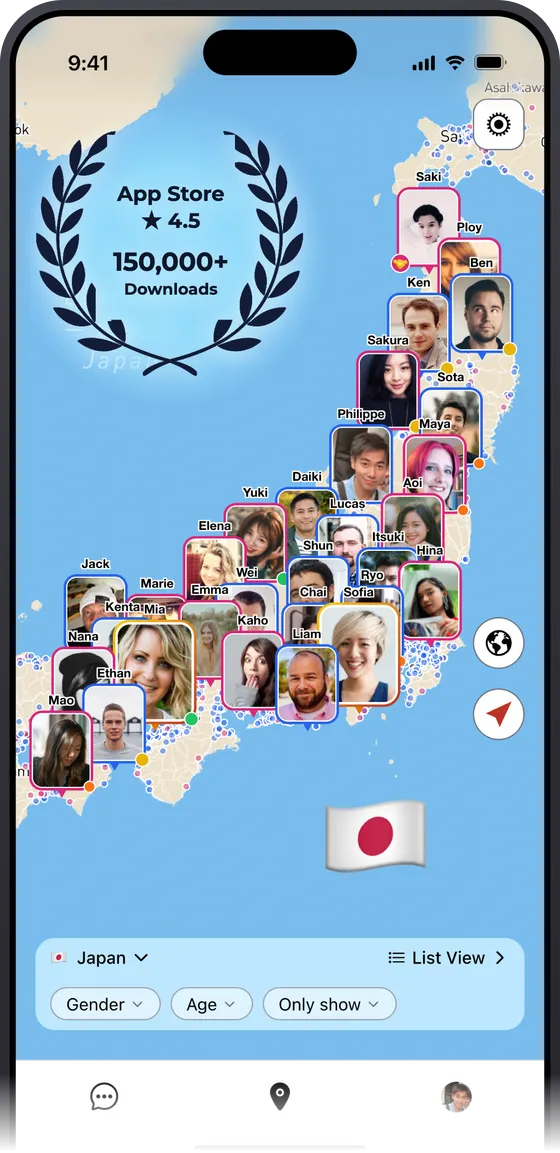
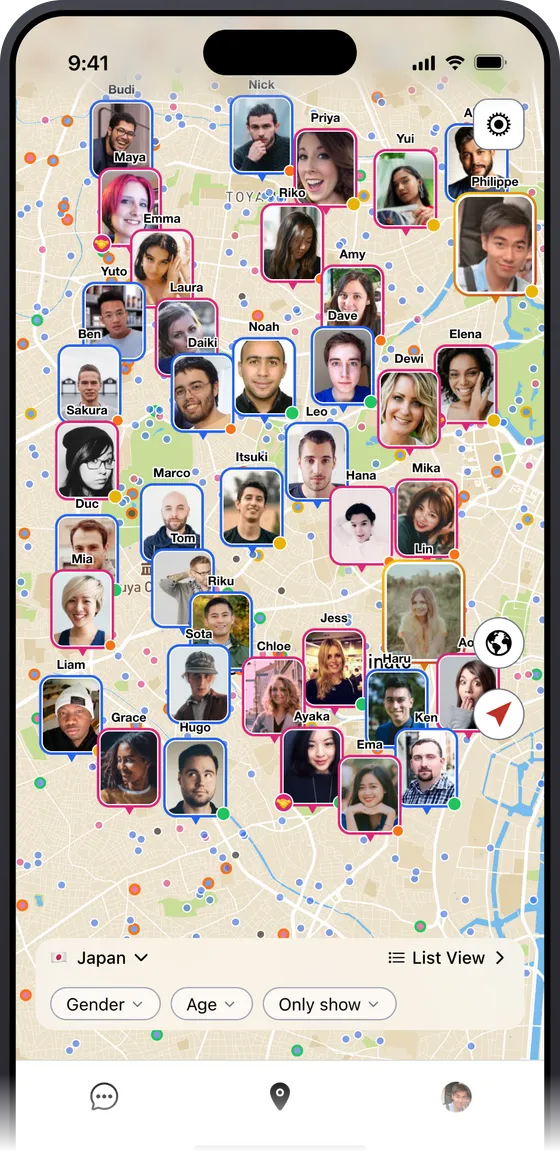
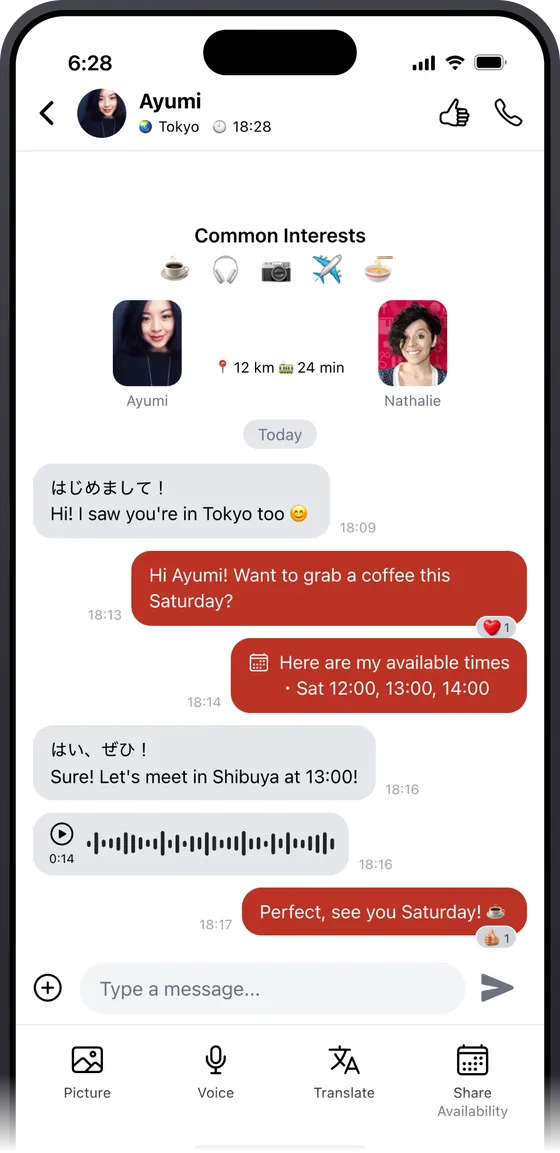


SewaYou is a map-based app for meeting both Japanese locals and other foreigners in your city, in person, this week. You can also explore anywhere on the world map. For support in person, focus on your area to find people who could sit at a table near you, hear your story, and give you a real read. The map shows who is nearby, locals and foreigners both, and everyone on it is open to actually meeting up rather than chatting forever in an inbox.
Two coffees a week, one with each side, is enough to start building the calibration that will save you from a year of misreading your own life. The country does not give you this network by default. You build it. The faster you start, the less of your time in Japan gets spent wondering if you are the problem.


