

You sent your coworker a quick reply. One sentence. You used the verb form you learned in chapter four. You used the right particle. You hit send and felt good about it.
Five minutes later they walk over to your desk, and they are visibly annoyed.
"You said you'd done it. Where is it?"
You did not say you had done it. You said you were doing it. You used 〜ています exactly the way the textbook taught you. Continuous action. Currently in progress. Not finished yet. The grammar was textbook clean.
Except they did not hear "I'm working on it." They heard "I've already handled it." And the worst part is that no Japanese teacher has ever told you they were going to hear it that way.

Here is the thing the textbook never gets around to telling you. 〜ています is not a single rule. It does two completely different jobs depending on the verb, the context, and what the listener was already expecting to hear.
Sometimes it means "currently doing this thing." 食べています. I am eating. Easy. That is the version chapter four teaches you.
But sometimes it means "this thing is done and the result is now sitting there." 結婚しています does not mean "I am getting married right now." It means "I am married." 知っています does not mean "I am in the act of knowing." It means "I know." 落ちています does not mean a thing is currently falling. It means it fell, and now it is on the floor.
So when you say 「今修正しています」 to a coworker who is already expecting the fix to be done, their brain runs the second pattern, not the first. They hear the resultant-state version. They hear "the fix exists, it's right there." And then they wait for the file. Grammatically correct. Practically misread.
The textbook is not lying. It is telling you the truth at the level of grammar. It just isn't telling you what humans do with that grammar at the speed of work.
You will be tempted, after a moment like this, to go home and study harder. Maybe drill the 〜ている chapter again. Maybe find a YouTube video that explains the dual meaning. That is a reasonable response. It is also mostly the wrong one.
The chapter you re-read tonight will give you the rule in isolation. The rule in isolation is already in your head. What you are missing is not the rule. What you are missing is the read.
The read is the part where you watch a real human's eyes glance at the clock, hear them sigh in a particular way, register that they were already expecting the fix, and pre-load the resultant-state interpretation before you even open your mouth. The read is what tells you to swap 「修正しています」 for 「あと十分かかります」 because the second sentence cannot be misheard, while the first one can. That kind of reading is not in any chapter, because it cannot be written down. It is something you build by being in conversations long enough that your gut learns to predict where a sentence is going to land.
Your textbook can take you to the door of fluency. It cannot walk through the door for you. The door is on the other side of a thousand small misunderstandings with patient people who don't punish you for them.
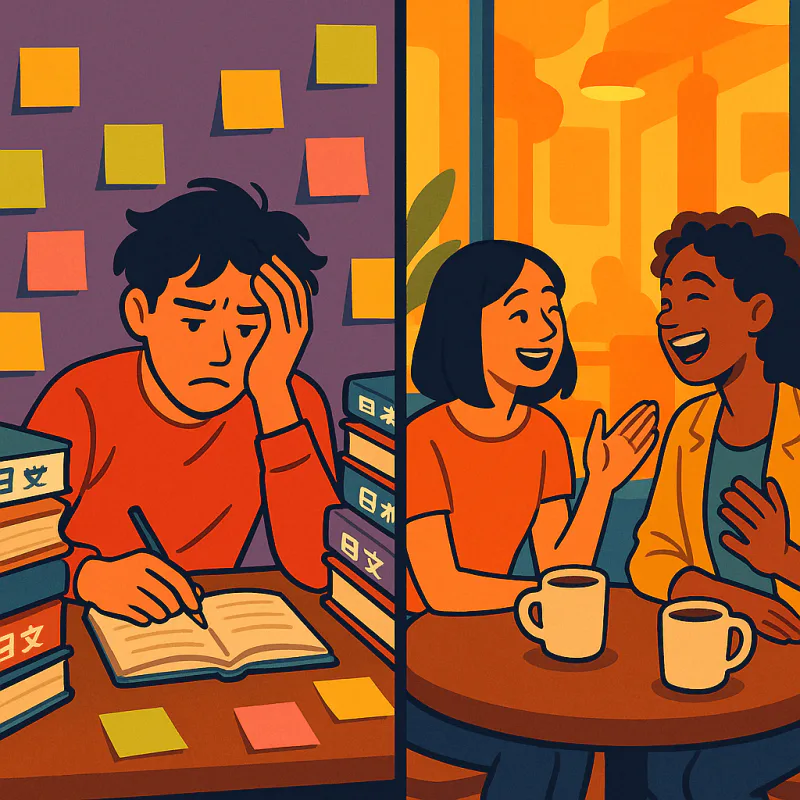
Here is the brutal part. The exact gap that's biting you, the gap between grammatically correct and practically heard, can only be closed by repeated exposure to real Japanese speakers in real situations. And the workplace is the worst possible place to get that exposure.
At work, every conversation is high stakes. The person across from you is not your tutor. They have a deadline. They have a boss. They are going to interpret what you said in whatever way is fastest for them, and they are going to react before you have time to clarify. You get one rep, you mess up, and now you are spending the rest of the afternoon untangling what they thought you meant. Then you avoid speaking up for the next two days because the cost of the last attempt was so high.
That is not how reflexes get built. High stakes plus low volume equals zero learning. Your brain does not rewire under threat. It rewires under safety, repetition, and slight challenge.
You need somewhere to make the same kinds of mistakes you made at the office, but with someone who is not going to escalate. Someone who can pause when you say something weird, ask "wait, did you mean it's done or you're still doing it?", and let you correct yourself out loud. Twenty minutes of that is worth a month of textbook drills.
The fix is dumb on paper and hard in practice. You need real conversations with real people, often, in low-pressure settings, where being slightly wrong does not cost you anything.
That is where the read gets built. Not at a desk. Not from a video. In a chair, across from a human, in real time.
You don't need a tutor for this. A tutor will correct your grammar, which you have already, more or less, in your head. You need someone who is not in a hurry, who is not grading you, who will say "huh, that came across funny, try again" without it costing you anything. A friend, in other words. Someone who is on your side while you are figuring this out.
The number of those conversations you stack in a year is roughly the number of misunderstandings you will not have at work. That is the trade. Cheap reps now in exchange for expensive misunderstandings later.

Find one Japanese speaker who has nothing on the line with you. Not a coworker. Not your landlord. Not the staff at the city office. Someone whose only role in the next hour is to enjoy a coffee and a conversation.
Tell them you want to practice. Tell them you mess up the 〜ている form sometimes and ask them to flag it when it happens. Most people will be flattered to be asked. The ones who aren't, you'll know in the first ten minutes, and you can move on to someone else.
Two of these per week, and the workplace stops feeling like a minefield. Not because your grammar improves. Your grammar is already mostly fine. Because your read gets sharper. You start hearing the version of your own sentence that the listener is going to hear, before it leaves your mouth.
That is what fluency actually is. Not knowing the rule. Knowing how the rule lands.
The hard part is just finding the person. Most of us don't have a Japanese friend lying around who happens to be free on Thursday afternoons. The classroom doesn't give you one. The dating apps are off-topic. Language exchange apps full of strangers in different time zones don't really count either, because the read happens in person.
Make Japanese Friends On a Live World Map
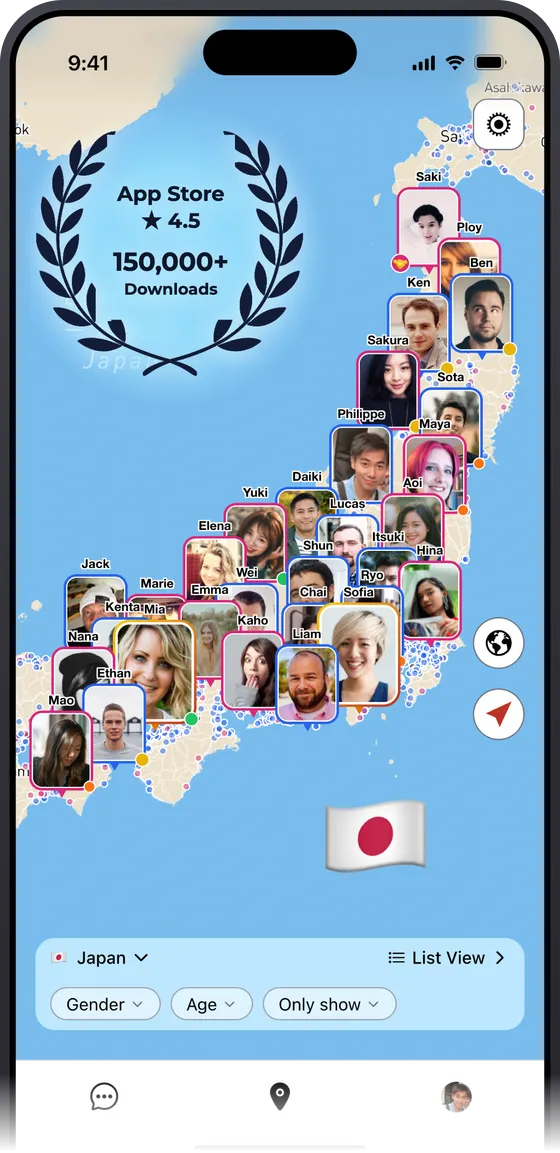
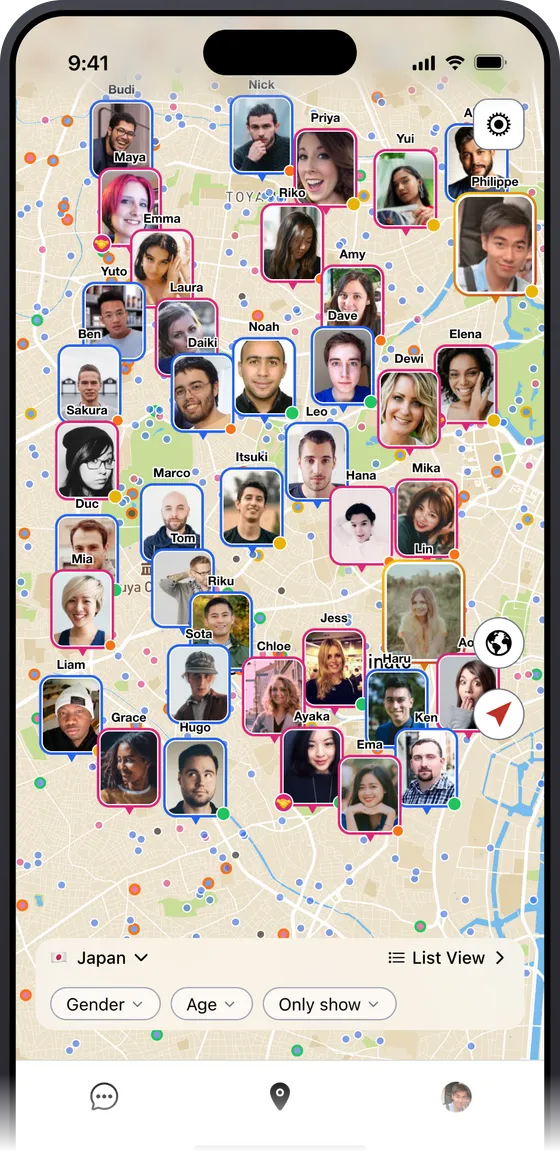
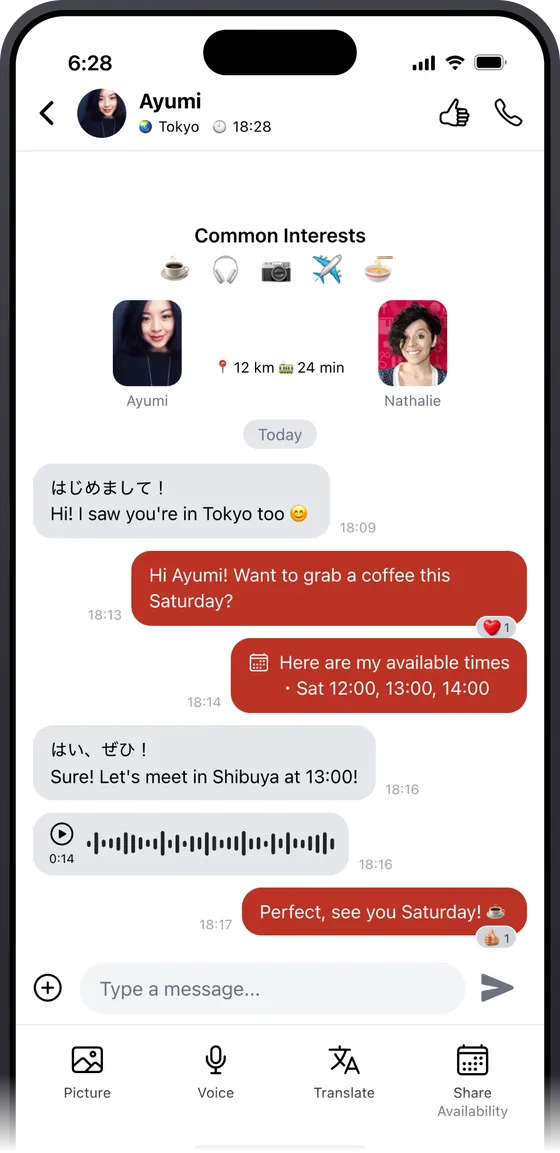


SewaYou is a map-based app for finding people who are actually nearby and who actually want to meet up. You can see who's in your city, who's also learning a language, and who's open to grabbing a coffee in person. Nobody is grading you. Nobody is on a deadline. Just a real chair, a real cup, and a real conversation where being wrong is fine.
The gap between grammatically right and practically heard closes one quiet afternoon at a time. Stack the afternoons.


